Worth Nothing, Worth Everything
What brands can learn from a $12 piece of cardboard

I have a piece of cardboard from the 90s that I will never, ever throw away.
It’s a sports trading card. Wayne Gretzky. The Great One.
Unforseen by the 7 year old me who purchased it, it’s not worth a God damn thing. But the sentimental value is on one-thousand. It’s basically a glorified, wax-embossed index card, printed with the same photo thousands of other kids had in 1996. But who cares. It’s mine, I’m never getting rid of it, and it’s sitting on the shelf right behind my head as I type this.
Gretzky might be the Great One, but we’re not talking about him today. We’re talking about The Chosen One. The kid from Akron. LeBron James.
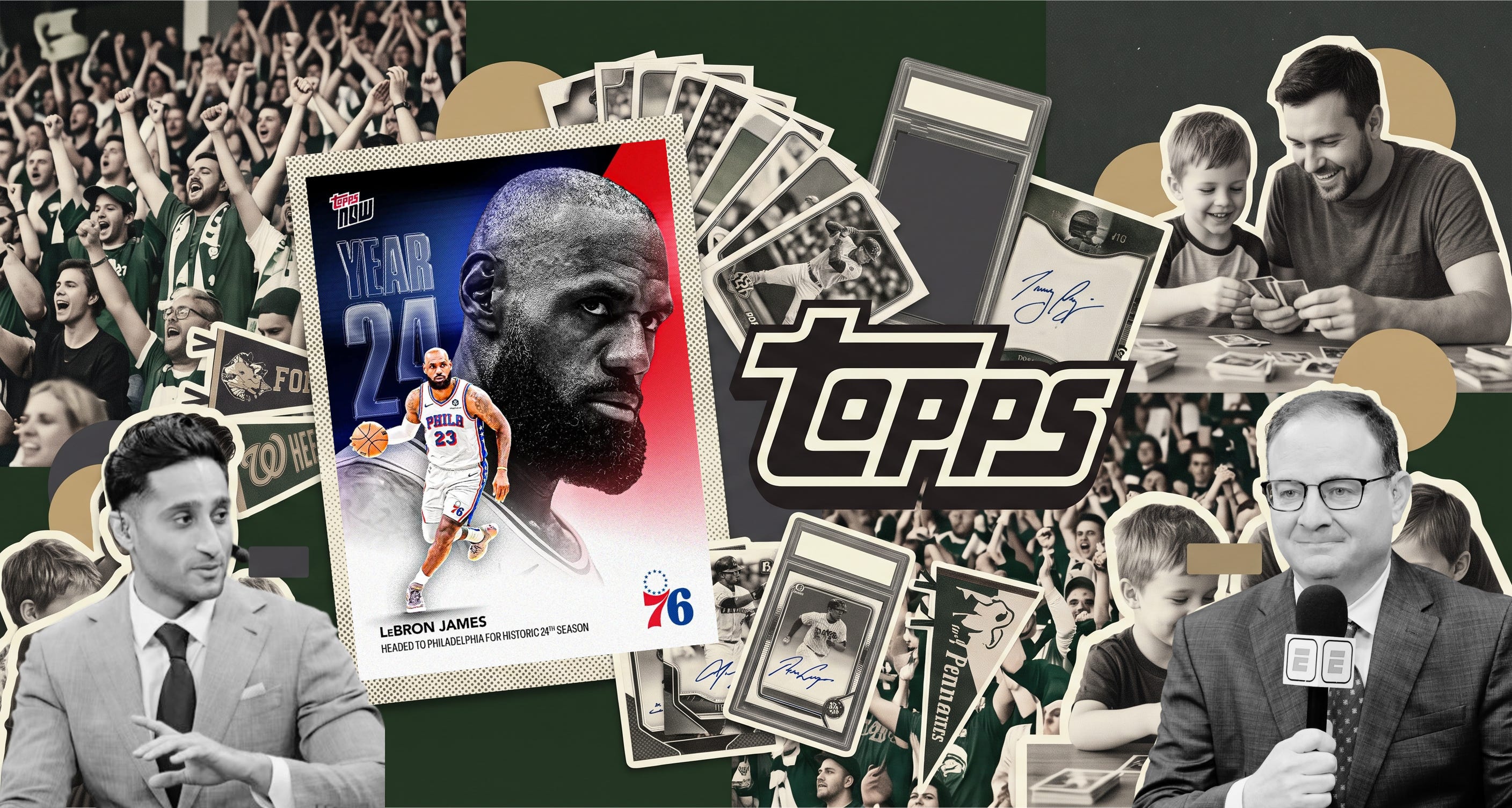
On July 24th, the biggest story in sports didn’t break on ESPN, Twitter, or through a press release. It broke on a $12 piece of cardboard. A trading card.
LeBron’s highly anticipated farewell tour move, announced not by Shams, Woj, Stephen A Smith, or any of the other top bosses of sports news. But by Topps – the O.G. trading card company, now owned by Fanatics.
A card of The Chosen One himself, already in a Philadelphia Sixers jersey, with a bold overhead “Year 24” graphic.
It’s not a rare card. Far from it. It was print-on-demand. Anybody with an internet connection and $11.99 could order as many as they wanted.
In a world of scarce Nike sneaker drops, the Topps LeBron card was the anti-scarcity. And yet within a few hours, they’d moved more than 100,000 of them. Read about it online and everybody is asking how exactly a thin piece of cardboard beat every heavyweight reporter in the country to the story.
That’s the wrong question. Reporters give out news. Nobody here was buying the news.
So if nobody was buying the news, and nobody was buying anything scarce or valuable, it begs the question: what in the actual f*ck was anybody buying?!
A Dead Frenchman Called It In 1912
I have a lot of stories from my days as a Sociology student at UC Berkeley. Most are not appropriate for the general public.
But every now and then I come across something that reminds me of my studies, and the LeBron story is one of them. It reminds me of one of my favorite books. A piece of literary art sure to make you think I’m an uppity-ass, latte-sipping, eye-contact-over-the-bridge-of-my-eye-glasses, biggity-ole-bitch.
The Elementary Forms of Religious Life by Emile Durkheim. An absolute banger from 1912.
Our boy Emile spent most of his life trying to figure out what religion actually is, and one of the terms he landed on was the totem. In the tribes he studied, he argued, what’s sacred isn’t some abstract belief floating in thin air. It’s a physical object. A carved stone, an emblem, a polished jewel. Something you can hold in your hand.
And his real point wasn’t even about the object. The tribe wasn’t worshipping the object itself. They were using it – the totem – as a way to worship themselves. The totem was simply touchable. It made the feeling real.
Fandom is the closest thing a lot of us have to religion, and it runs on the same mechanics. Devotion. Tribes. Weekly gatherings. Saints and villains. And it carries the same baggage every religion always has: the feeling is simultaneously massive and invisible. You can love a player, a team, a moment with your whole damn chest, and have absolutely nothing in your hands to show for it.
A card fixes that. A card turns the feeling into a totem.
A ticket stub for your belief and devotion. Proof it happened. Evidence.
That’s what the f*ck people were buying.
By this definition, $11.99 for something that important is an absolute steal. And if there’d only been, say, 10 of these cards, imagine the lengths fans would’ve gone to for one.
So why did Topps make the obviously dumb decision to let anyone print as many as they wanted for 12 bucks?
A Feeling With Nowhere To Go
Durkheim had a second term that matters, and it’s the one Topps – like every great sports brand – understands better than anything.
Collective effervescence.
It’s my all-time favorite term from college. Beyond being the kind of word that drove Berkeley girls crazy at parties (you think I’m joking. I am not. Nerds), it doubles as the perfect name for a cheesy 90s rock band that never materialized.
More than that, it describes maybe my favorite thing in life. The reason nothing will ever top a live sports game, a concert, a festival, any large human gathering (Larpers, you too). Collective effervescence is the electricity that builds when a big group of people, all feeling the same enormous thing at the same time, gather in one place.
It’s what makes a crowd feel euphoric and larger than life. Holy, even. And it’s fleeting. It sparks, spreads like wildfire, and goes out. And when it goes out, you’re left wanting to put that feeling somewhere, because it never feels like enough.
Every buzzer-beater you ever walked out of just made you crave the next one with more fiendish energy. Every encore you witnessed, through thick plumes of pot smoke and bloodshot eyes, only made you ask “where’s the after party?”
So look at the week right before LeBron’s card dropped.
Six days earlier, the World Cup Final. The entire sports tribe lit all the way up, hundreds of millions of people carrying a charge with nowhere to send it. The week before that, Fanatics Fest took over the Javits Center: over 200,000 people, hundreds of athletes, every famous sports creator known to man. I was there. It doesn’t read as a trade show. It’s a revival. A religious gathering for people who love this stuff, all that effervescence packed into one building.
And then it ended.
The tribe left standing there, still buzzing, holding all that feeling with nothing to do with it.
That’s the vacuum Topps dropped the totem into. They put a physical object in reach at the exact moment a hundred million people were looking for one.
A day earlier it’s a novelty. A month later it’s merchandise. Right now? It was a lightning rod.
Which raises the bigger question. Why now?
Been There. Done that.
Cards have existed for decades upon decades. Why are they roaring back now, this hard, with this much money behind them?
eBay did more than a billion dollars in sports cards in the first half of this year alone. That’s never been done before. And it’s only a slice: the broader US card market sits somewhere around fifteen billion. The easy read is nostalgia. People remembering something they loved and introducing their kids to it. Or, like bell bottoms and baggy jeans coming back around every few decades, a yearning for years gone by. A simpler time.
This is not nostalgia. It’s a full-on pendulum swing. And if you blink, it’s going to swing back and kick you right in the ass.
Because this pendulum is a counter-attack. A right hook after a boxer’s bob and weave.
The last time I saw a pendulum this violent was 2013. That one was made of plastic. Vinyl came roaring back not in spite of streaming, but because of it. While I was busy building Pandora into the #1 streaming service in the US, Spotify, Apple, Amazon, and more behemoths all piled into the market. The streaming wars had begun, and music dissolved into an infinite feed you could never hold in your hand. Entire generations paying actual money to own absolutely nothing.
So back came the physical object. Something with weight to it. Something that says “I chose this,” that sits proudly on a shelf where people can see it. A physical manifestation of your taste.
Cards are that same instinct, pointed at sports fandom.
With the ticket industry in crooked shambles, most Americans simply can’t afford to go to a game. The matches live on screens, across 12 different apps, highlights reduced to fleeting, bite-sized chunks on our feeds.
Our favorite thing, sports, has become a relationship with pixels we rent from a platform.
When that happens, the piece of cardboard becomes the one part we actually own.
That’s what we saw on July 24. 100,000 people bought an unsigned card that will never, ever be rare or worth anything, and they knew it when they added one to their cart. They weren’t buying an investment. Treating cards as some crypto bubble misses the entire point.
The market isn’t drowning in worthless cardboard. It’s starving for meaning.
Minting The Moment
For brands, there’s one move, and it’s the most important one in the fandom economy right now. I call it Minting the Moment.
You make the physical thing at the exact instant a feeling peaks, and you let as many people as possible hold it.
Not a drop scheduled for next month. Not a commemorative set you order in the offseason on QVC. The totem is minted live, the moment the news is news and the tribe is buzzing.
That’s exactly what Topps did. They turned LeBron’s signing into something fans could hold before the press conference even started.
And they orchestrated it beautifully. The $12 card is the totem everyone can have, the thing the tribe gets to share. But sitting on top of it? One single one-of-one card, signed by LeBron himself. One crown jewel above 100,000 shared totems.
Something for the congregation, and something sacred for the altar.
The TLDR? Brands, we need to move past the “chasing attention” game. Attention is everywhere. It’s worth nothing.
Give the tribe something to hold, and you turn attention into fandom.
Old News. Minted.
By breakfast the next day, the news was old. In today’s world it always is. The “biggest news” evaporates into the feed alongside everyone else’s slop.
But out there in reality? Over 100,000 pieces of cardboard are sitting proudly on shelves, desks, and display cases across the country. And unlike the news, they’re not going anywhere. Each one is a little piece of proof. I was here for this. I cared. I kept something.
The question this leaves me with, and it’s the one I’d put to anyone building something people love:
You already know how to reach them. But so does everyone else.
What are you giving them to hold?
Get excited about sports, music, creators and all things fandom? Follow along. This is the kind of content you’re going to get here that you won’t get anywhere else.